8 min read ·
Buy an H100 or rent one: a payback calculation
What owning an H100 really costs: the card, power, hosting and idle time. A break-even formula in hours of rental, with a worked example and live rental prices.
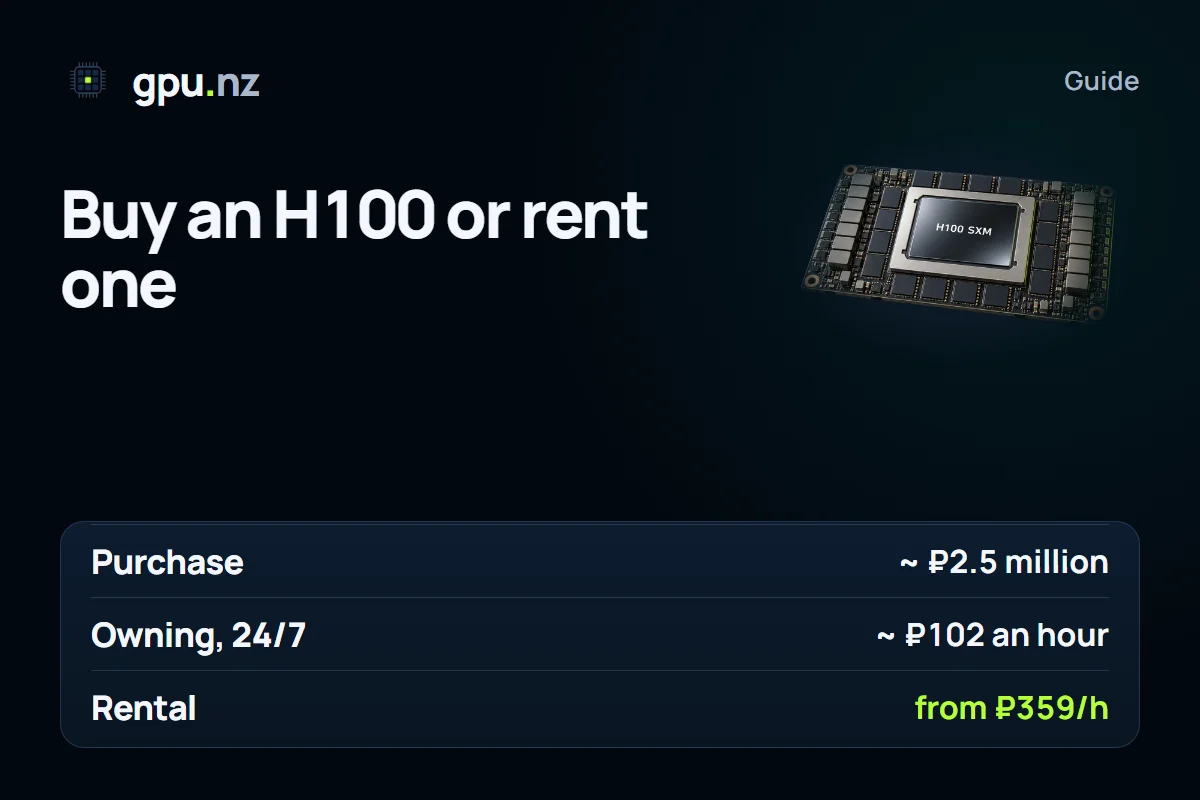
Buying an H100 pays off when the load is nearly constant for years. If you need the card for a few weeks a year, renting is cheaper, because you pay only for the minutes it runs. To decide, compare the full cost of ownership over the card's working life with the rental cost for the same hours. Below is how to run that comparison, with an example that uses a rough purchase price.
What your own H100 costs
The purchase price of one H100 is roughly 2.5 million roubles. This is an estimate, not a price list: prices of server GPUs change and depend on the supplier, the form factor and the exchange rate. The H100 comes as a standalone PCIe card and as an SXM module that goes into a server with several GPUs. For renting an H100 by the minute, see the H100 page.
The full cost of ownership
The card price is only part of the cost. Count every item:
| Item | What to include | How to estimate it |
|---|---|---|
| Card or server | A single card does not work without a platform: you need a server, memory, networking and disks | The price of the whole system, divided by the number of GPUs in it |
| Depreciation | The period over which the card loses value for your work | The cost divided by the lifetime in years; three to five years is common |
| Electricity | Draw under load: about 700 W for the SXM version and 350 W for PCIe | Power in kilowatts × hours × tariff per kWh × cooling factor |
| Hosting | A rack in a data centre, colocation or your own room with cooling | The site's tariff, or your share of air conditioning costs |
| Networking and upkeep | An internet link, replacing parts, and an administrator's time | A fixed sum per year |
| Opportunity cost | Money tied up in the card could earn interest on a deposit | The purchase price × the deposit rate |
| Idle time | Owning the card costs money even when it sits idle | Included if you count in calendar hours |
The break-even formula
Buying pays off once the yearly cost of ownership falls below what you would pay to rent the same hours.
F = fixed costs per year (depreciation, rack space, networking, upkeep)
v = variable cost per hour of running (electricity with cooling)
R = rental price per hour
H* = F / (R − v)  — hours of work per year at which buying and renting cost the same
H* / 8760  — the share of the year from which buying starts to pay off
If H* is above 8,760 hours, buying does not pay off even at round-the-clock use. The closer R is to v, the faster H* grows: if renting costs about the same as electricity, owning never pays off. Take R from the catalogue; the current hourly prices are shown on this page below.
A worked example
Take one H100 at the rough price of 2.5 million roubles, with a three-year working life and no residual value. For simplicity, count only depreciation and electricity. Rack space, networking, upkeep and the server itself are not included, so real ownership costs more.
- Depreciation: 2,500,000 roubles over three years is about 833,000 roubles a year, or about 95 roubles for each calendar hour.
- Electricity: 700 W under load, a tariff of 7 roubles per kWh (an assumption for this example, replace it with yours) and a cooling factor of 1.5 give about 7.4 roubles per hour of running.
- At round-the-clock load, electricity comes to about 64,000 roubles a year.
So, at round-the-clock use, ownership costs about 102 roubles per calendar hour before other costs. Buying beats renting only if the hourly rental price is above that figure, and rack space, networking and upkeep raise the threshold further.
For partial use, put the rental price R from the catalogue into the formula H* = 833,333 / (R − 7.4) and divide the result by 8,760. If the card is needed for fewer than H* hours a year, renting is cheaper. For example, at 2,000 hours a year, compare 2,000 with H*: if H* is larger, renting wins.
Do the same for other cards: enter your own purchase price, working life and power draw. For an A100 or an RTX PRO 6000 with 96 GB, the threshold will be different.
If the card sits in a server with other GPUs, the server, networking and rack costs are shared between the cards. Then do the calculation for the whole system and divide the result by the number of GPUs.
How to count utilisation honestly
Utilisation is the share of calendar time in which the card does useful work. It is often overstated: people count the hours when the server is switched on but barely loaded, and forget environment setup, restarts and waiting for data. The honest figure is the hours of real computation, divided by 8,760.
To find your own figure, count over the last two or three months how many hours the card ran under load and how many it sat idle. Use that number in the calculation instead of an assumption.
The cost of a working hour
The table shows what one hour of real work costs from a card you own. It uses the same assumptions as the example above: a price of 2.5 million roubles, three years, 700 W, a tariff of 7 roubles per kWh and a cooling factor of 1.5. The lower the utilisation, the more each working hour costs.
| Utilisation per year | Hours of work | Ownership per year, roubles | Cost per working hour, roubles |
|---|---|---|---|
| 25% | 2,190 | about 849,000 | about 388 |
| 50% | 4,380 | about 866,000 | about 198 |
| 75% | 6,570 | about 882,000 | about 134 |
| 100% | 8,760 | about 898,000 | about 102 |
If renting costs less than the cost of a working hour at your utilisation, buying does not pay off. Compare the last column with the price in the catalogue on this page: that is the central question of the calculation. The table leaves out rack space, networking and upkeep, so the real cost of a working hour is higher.
A concrete case: at 1,500 hours of work a year (about 17% of calendar time), owning costs about 563 roubles per working hour. That is 833,333 roubles of depreciation plus about 11,000 roubles of electricity, divided by 1,500 hours. Renting is cheaper if its hourly price is below that figure.
What changes over time
Card prices, driver support and resale demand all change. A new generation usually lowers the value of the previous one, but how fast depends on the market. A three-year calculation therefore rests on an assumption, not a forecast. The longer you own a card, the more upkeep and obsolescence matter, and resale can change the result considerably.
Lead time and start-up
Time passes between the decision and the first run: delivery, preparing the room, installation and testing. The money is already spent during that time, while the card is not yet working. If the project has a fixed date, include this lead time in the calculation, not only the cost of ownership.
A checklist before you decide
- You have counted your real utilisation over recent months, not the expected one.
- You know where the card will stand, how much power it draws and who maintains it.
- You have a plan for its working life: what happens to the card in three years, and who could buy it or take it over.
- You have compared the cost of a working hour with the rental price for the same period.
- You have decided how to handle peaks: cover them by renting, or keep spare capacity.
When buying makes sense
- The load is nearly constant: training or inference running round the clock for several years.
- Space, power and cooling are already in place, and a team that can maintain servers runs them.
- The data may not leave the premises under legal or contractual requirements.
- The configuration is known in advance and does not change for years.
When renting is the better choice
- The load comes in waves: a week of training, experiments, a peak before a release.
- You need different cards. In the catalogue, switching card takes minutes, while in your own fleet every new card is a new purchase. For fine-tuning and large models, renting for the length of a project is often enough.
- Generations change quickly: a newer card may finish the job faster, and a purchased card can lose value before its depreciation period ends.
- There is no team to keep servers running: drivers, cooling and replacing parts.
- The task is not yet clear: test the model on a rented server first, then decide about buying.
A hybrid approach
It is often sensible to keep the steady base load on your own card and cover the peaks by renting. The break-even point then applies only to the base load. Peak hours are best covered by renting by the minute, so you do not keep a spare card for a few peaks a month. For batch work, interruptible servers save money, and the general rules are in the guide on not overpaying for GPU rental.
The prices in the block below come from the catalogue and change with it. The general rules for tariffs are on the pricing page.
Questions and answers
- How much does an H100 cost in roubles?
- As a rough estimate, about 2.5 million roubles for one card. Prices change and depend on the form factor. Rental is billed by the hour, and the current price is in the catalogue on this page.
- Does buying an H100 pay off?
- It can, when the load is close to round-the-clock for several years. For a few weeks of work a year, renting is cheaper.
- How many hours must a card run before buying pays off?
- Divide the fixed yearly ownership costs by the difference between the hourly rental price and the hourly electricity cost. The result is the number of hours a year at which the two options cost the same.
- What belongs in the cost of owning a GPU?
- Depreciation, electricity with cooling, rack space, networking, upkeep and the return the money could have earned elsewhere. One card does not work without a server.
- Which is better to buy, an A100 or an H100?
- It depends on the workload and the memory it needs. The H100 is the newer generation and is faster on most tasks, while the A100 costs less. Compare the price and power draw of the exact model you are considering.
- Can I combine buying and renting?
- Yes. Keep the steady base load on your own card and rent for the peaks. Calculate the break-even point only for the base load.